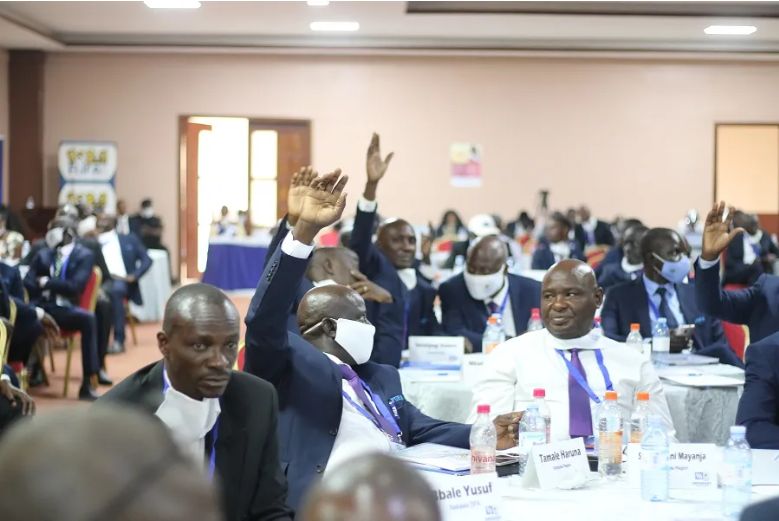
FUFA Statute Amendments must go beyond compliance and embrace real football democracy
- FEATUREDNEWS
- May 30, 2026
- No Comment
By Emmanuel Sekago
As the Federation of Uganda Football Associations (FUFA) prepares to hold an Extraordinary General Assembly on June 4, 2026, to amend the FUFA Statutes 2025, the moment presents a rare opportunity to address long-standing governance concerns that have repeatedly generated debate within Ugandan football.
According to a circular dated May 20, 2026, signed by FUFA Chief Executive Officer Edgar Watson and seen by Wallnetnews Digital, the Extraordinary General Assembly will be conducted virtually pursuant to Article 30 of the FUFA Statutes, with the sole agenda being amendments to the federation’s governing framework.
While statute amendments are necessary, the question many stakeholders are asking is whether the proposed changes will address the real governance challenges that have persisted within Ugandan football for years.

If FUFA is genuinely committed to strengthening governance, transparency, accountability and democratic participation, then the amendments should not merely focus on satisfying regulatory requirements. They must tackle the structural issues that continue to restrict competition for leadership and limit meaningful participation by football stakeholders.
One of the most contentious issues remains the highly restrictive eligibility criteria for candidates seeking the presidency of FUFA. Under the current framework, eligibility is effectively confined to a small circle of individuals already serving within the federation’s executive structures.
In practical terms, a country of more than 45 million people finds itself in a situation where only a handful of individuals can realistically contest for the highest office in football administration.
Such restrictions undermine the very principles of democracy, competition and inclusivity that football itself promotes on the field.
The nomination process is equally problematic. Prospective candidates are required to obtain endorsements from regional chairpersons and secretaries, as well as representatives of special interest groups. Yet many of these individuals operate within structures closely aligned to or dependent on FUFA.
This creates a significant conflict of interest and erects barriers that discourage capable administrators, former players, football investors and other qualified stakeholders from seeking leadership positions.
A genuinely democratic football federation should lower unnecessary nomination barriers while maintaining reasonable integrity checks to ensure credible candidates emerge.
Another reform that deserves serious consideration is the introduction of presidential term limits. Across modern sports governance systems, term limits are increasingly recognised as an important tool for promoting accountability, leadership renewal and institutional stability.
Two terms are sufficient for any football president to implement a vision, build structures and leave a lasting legacy. Leadership transition should not be viewed as a threat but rather as a healthy feature of strong institutions.
Term limits help prevent the concentration of power, encourage fresh ideas and reduce the risk of governance stagnation.
The issue of resource distribution also requires urgent attention. FUFA receives substantial support from FIFA, CAF, government and commercial partners on behalf of football development in Uganda. Yet many stakeholders continue to question whether the federation’s member associations and clubs adequately benefit from these resources.
Currently, a significant proportion of available funding appears concentrated on administration and national team activities. While national teams remain important, football development cannot thrive without meaningful investment at grassroots, district, regional and club levels.
Members who constitute the foundation of Ugandan football should see tangible benefits from the resources mobilised in their name.
The proposed amendments should also incorporate clear eligibility standards for presidential candidates in line with FIFA Statutes, the FIFA Electoral Code and the FIFA Code of Ethics. Establishing objective and transparent qualification requirements would strengthen the credibility of future elections while protecting the integrity of the federation.
Equally concerning is the decision to conduct the Extraordinary General Assembly virtually. While technology offers convenience, governance processes of this magnitude demand maximum transparency and participation.
Questions inevitably arise regarding verification of attendance, quality of debate, voting transparency and stakeholder observation. A physical assembly would provide greater accountability and allow delegates to fully engage with proposed amendments in an open environment.
The timing of these amendments is particularly significant given the ongoing compliance exercise being undertaken by the National Council of Sports (NCS) under the National Sports Act and National Sports Regulations 2025.
Earlier this week, NCS General Secretary Dr Bernard Patrick Ogwel reminded sports federations that the five-month remedial compliance period granted by the NCS Board expires on June 7, 2026. Organisations that fail to fully comply risk losing official recognition under the law.
The compliance process requires sports bodies to align constitutions with national legislation, strengthen governance systems, establish accountability mechanisms and regularise their operations.
For FUFA, this should be more than a box-ticking exercise. It should be an opportunity to modernise governance and rebuild confidence among stakeholders.
Football remains Uganda’s most popular sport. Its governing structures should therefore reflect the highest standards of democracy, transparency and accountability.
The forthcoming Extraordinary General Assembly offers a chance to deliver meaningful reforms that open leadership opportunities, strengthen member participation, improve financial inclusivity and align football governance with both national law and international best practices.
The objective should not simply be compliance with regulatory requirements. The objective should be building a stronger, more democratic and more accountable football federation capable of serving the interests of all Ugandan football stakeholders.