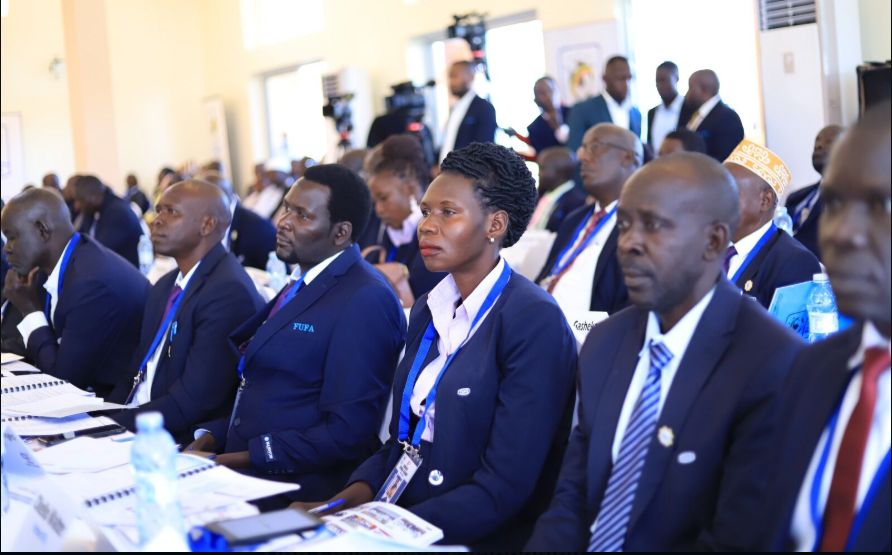
FUFA at a crossroads as stakeholders question closed Extraordinary General Assembly
- FEATUREDSPORTS
- June 1, 2026
- No Comment
By Emmanuel Sekago
The Federation of Uganda Football Associations (FUFA) finds itself at a critical governance crossroads ahead of its Extraordinary General Assembly scheduled for June 4, 2026, with growing concerns emerging from stakeholders over the decision to conduct the meeting virtually and restrict participation to eligible delegates only.
While the assembly has been convened to consider and adopt proposed amendments to the FUFA Statutes 2025, questions are being raised about transparency, accountability and stakeholder engagement in a sport that remains a matter of significant public interest.
According to a circular dated May 20, 2026 and signed by FUFA Chief Executive Officer Edgar Watson Suubi, the Extraordinary General Assembly will take place virtually starting at 9:30 a.m., with participation links to be shared exclusively with eligible delegates from member associations, clubs and recognized football structures.
The primary purpose of the meeting is to discuss and adopt amendments to the FUFA Statutes 2025 as part of efforts to align the federation’s governance framework with the National Sports Act 2023 and other applicable legal requirements.
The proposed amendments focus on strengthening governance, accountability and transparency structures, updating membership rights and obligations, refining electoral procedures, enhancing women’s football and inclusion provisions, improving disciplinary and dispute resolution mechanisms, and updating financial management and administrative processes.
FUFA maintains that the revisions are intended to ensure compliance with Ugandan law while remaining consistent with FIFA and CAF regulations.
However, some stakeholders argue that the process itself risks undermining the very principles of transparency and accountability that the amendments seek to promote.
Football remains Uganda’s most followed sport, attracting millions of supporters, substantial government investment, sponsorship funding and public interest. Decisions affecting the governance and future direction of the game extend beyond delegates and member associations and directly impact clubs, players, coaches, administrators, sponsors, fans and the wider football ecosystem.
It is against this backdrop that calls are emerging for greater openness during the Extraordinary General Assembly.
Many stakeholders believe the National Council of Sports (NCS), which is currently overseeing compliance with the National Sports Act 2023, should intervene and ensure that observers, media representatives and other interested stakeholders are granted access to monitor proceedings.
The argument is straightforward. If the amendments are intended to improve governance, transparency and accountability within football administration, then the process through which those amendments are adopted should itself reflect those same values.
Concerns have also been raised about the practical challenges associated with a fully virtual assembly. Questions remain regarding verification of attendance, participation levels, voting integrity and whether all eligible delegates will have equal access to the proceedings.
Critics argue that a hybrid or open model would better promote confidence in the process while allowing media and stakeholders to observe discussions without interfering with the decision-making role reserved for delegates.
The timing of the assembly is equally significant.
The National Council of Sports recently reminded all sports federations and associations that the compliance window granted under the National Sports Act and National Sports Regulations 2025 expires on June 7, 2026. Organisations that fail to fully align their constitutions and governance structures with the law risk losing their certificates of recognition.
As one of the country’s largest and most influential sports federations, FUFA’s compliance process carries broader implications for sports governance in Uganda.
The June 4 assembly therefore represents more than a routine statutory review. It is an opportunity for FUFA to demonstrate its commitment to modern governance principles and reinforce public confidence in football administration.
As the federation prepares to debate amendments that will shape the future of Ugandan football, stakeholders are hoping the process will embrace not only legal compliance but also the transparency and openness expected of institutions entrusted with managing the country’s most popular sport.
Whether the concerns raised will prompt greater access for observers and the media remains to be seen, but one thing is certain: the decisions taken at the Extraordinary General Assembly will have lasting consequences for the governance and development of football in Uganda.