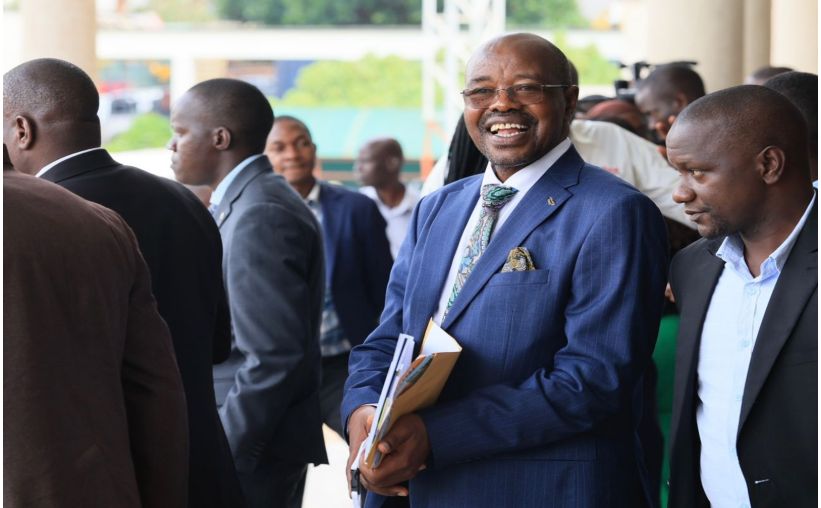
Parliament completes vetting of Cabinet and State Ministers as appointees outline key priorities
- FEATUREDNEWS
- June 3, 2026
- No Comment
By Our Reporter
Parliament has concluded the vetting of Cabinet and State Ministers recently appointed by President Yoweri Museveni, with several ministers-designate outlining their priorities for the new term, including combating corruption, improving service delivery, strengthening healthcare, and enhancing education.
The two-day vetting exercise was conducted by the Appointments Committee chaired by Speaker Rt. Hon. Jacob Marksons Oboth.
Among the issues that featured prominently during the vetting process was the fight against corruption, with several ministers-designate pledging to strengthen accountability and improve efficiency within their respective sectors.
The State Minister for Local Government, Hon. Justine Nameere, said tackling corruption within local governments would be one of her immediate priorities. She noted that numerous reports from whistleblowers point to significant revenue leakages caused by under-declaration of local government revenues.
“The revenues at cities, districts and divisions are being under-declared. A city is collecting UGX 1.7 billion, but an errant town clerk will tell you they are collecting UGX 20 million. That is a huge leakage. We must ensure government programmes are alive and also buttress the supervisory role,” Nameere said.
The State Minister for National Guidance, Hon. Alioni Yorke Odria, proposed the use of digital technology as a tool to combat corruption across government institutions.
“Through the ministry, we are going to introduce software that we shall use to fight corruption, be it through phone calls or bank systems. We shall work with other ministries to ensure that this fight is done across the board,” Odria said.
The newly appointed State Minister for Public Service, Hon. Lydia Wanyoto, pledged to address concerns surrounding recruitment, promotions, and staffing within the public service.
She said her ministry would work to eliminate corruption in recruitment processes and ensure that employment opportunities are awarded on merit.
“I have heard severally that there are many people in acting capacity, that there are challenges of promotions. There are reports of public service boards asking for bribes to give jobs. We shall ensure that Ugandans who qualify go through due recruitment processes and that no Ugandan pays for a public service job,” Wanyoto emphasized.
On the health sector, the State Minister for Primary Health Care, Hon. Charles Ayume, urged Ugandans to remain calm following recent Ebola cases reported in parts of the country.
Ayume stressed that there was currently no justification for imposing a lockdown and assured the public that the Ministry of Health was closely monitoring the situation.
“We are guided by scientific evidence, so we should not panic. A lockdown is usually the last measure but right now, the Ministry is doing whatever it takes through surveillance, creating awareness and early warning systems,” Ayume said.
In the education sector, the State Minister for Primary Education, Hon. Phyllis Chemutai, pledged to improve learning conditions in Universal Primary Education (UPE) schools, with particular focus on infrastructure development and school feeding.
“There is also a problem of poor feeding of primary pupils and many parents cannot afford the feeding policy. This causes children to perform poorly and drop out of school. I will advocate that children are given food to sustain them in school,” Chemutai said.
Meanwhile, the Minister for Foreign Affairs, Amb. Adonia Ayebare, pledged to strengthen coordination among government institutions involved in implementing Uganda’s foreign policy.
“This will ensure that we are all well-coordinated in delivering effective implementation of our foreign policy, which is based on patriotism, regional integration and Pan-Africanism,” Ayebare said.
The role of the Appointments Committee is provided for under Rule 173 of the Rules of Procedure of Parliament, which mandates the committee to approve, on behalf of Parliament, individuals nominated by the President for appointment to public office.
Following the completion of the vetting exercise, the Speaker is expected to formally communicate the committee’s decisions to the President in accordance with Rule 177 of the Rules of Procedure.
“The Speaker shall communicate to the President in writing, within three working days after the decision of the Committee on Appointments, on any person nominated by the President for appointment,” the rule states.
The completion of the vetting process paves the way for the newly approved ministers to assume office and begin implementing government programmes under the 2026–2031 administration.