


Games teachers laud USSSA for safeguarding capacity building training
- FEATUREDSPORTS
- May 19, 2026
- No Comment
By Emmanuel Sekago
To ensure players, games teachers, coaches, medics, and other officials are protected from abuse and victimization, stakeholders at the ongoing 2026 USSSA National Boys Football Championship in Lira City have applauded the Uganda Secondary Schools Sports Association (USSSA) for prioritising safeguarding through capacity building training.
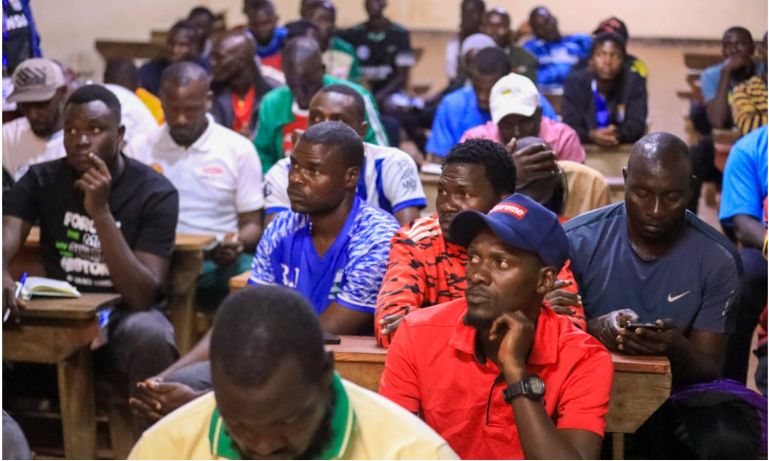
More than 130 participants on Monday night attended a mandatory safeguarding session held at Lira Town College involving games teachers, coaches, medics, and officials from the 64 schools competing at the national championship.
The purpose of safeguarding is to promote the safety, protection, and well-being of all participants by creating a secure and supportive environment free from abuse, harassment, neglect, and exploitation.

The session was facilitated by Grace Viola Kyolaba together with safeguarding instructor Reginah Nakibuule.
Speaking to Wallnetnews Digital, Kyolaba said the response and interaction from participants was encouraging and educational.
“Generally the attendance was good. Interaction with this particular group was educational, and some of the issues aired initially seemed normal until after the session when the mentality changed,” Kyolaba said.
She revealed that participants requested USSSA to extend safeguarding sessions to grassroots levels ahead of district and zonal competitions.
“They requested that sessions be organized at the grassroots as far as districts ahead of the USSSA district qualifiers for Ball Games Two and zonal competitions,” she added.
Nakibuule applauded USSSA and the head of capacity building for integrating safeguarding into sports development programs across the country.
“I thank USSSA and the head of capacity building for adding safeguarding to their program. Over 1,500 participants were trained in safeguarding, including players, games teachers, coaches, medics, and media personnel,” Nakibuule said.
She explained that many athletes admitted they previously did not understand safeguarding and were unaware that some actions amounted to abuse.
“Many athletes said they were excited about the training because they previously didn’t understand safeguarding, especially what constitutes abuse. Some were already experiencing abuse but didn’t recognize it or know how to report it,” she noted.
Nakibuule further revealed that athletes proposed the inclusion of safeguarding officers’ contacts on accreditation tags or the establishment of confidential reporting hotlines.
“The athletes requested that safeguarding officers’ contact details be added to game tags, or that a hotline be set up outside of games, so they could report concerns safely. Many find it difficult to report to people around them because they don’t trust them, and in some cases, those people are the abusers.”
According to Nakibuule, several coaches and games teachers also admitted they had not realized that some of their conduct could amount to abuse.
“Games teachers and coaches were receptive, with many admitting they hadn’t realized that some of their own actions counted as abuse. Several requested that the program be extended to their regions since not everyone gets the chance to attend regional events, but everyone deserves protection.”
She emphasized that continuous safeguarding education remains critical for the future of sports in Uganda.
“To ensure our players, coaches, and others aren’t victimized tomorrow, ongoing training and awareness on safeguarding are essential,” Nakibuule stressed.
Meanwhile, Calvin Opio, the games teacher of Amus College School, praised USSSA for conducting timely safeguarding sensitisation sessions.
“We applaud USSSA for taking us through the safeguarding dos and don’ts. This training came at the right time because truthfully many of us were still green about safeguarding,” Opio said.
“Having this training has really helped us understand how to handle athletes better. My only appeal to USSSA is to organize similar training in all districts and the nineteen zones so that schools qualifying for nationals already understand safeguarding.”
He added that all games teachers across districts should undergo safeguarding training to promote safer sporting environments for student-athletes nationwide.


