Buzeki urges Kampala residents to take responsibility for garbage collection and City cleanliness
- FEATUREDNEWS
- November 1, 2026
- No Comment
By Our Reporter
Kampala Capital City Authority (KCCA) Executive Director Sharifah Buzeki has challenged residents to take responsibility for the waste they generate, emphasising that keeping the city clean starts at household level and requires individuals, businesses and institutions to pay for proper garbage collection.
The message during Saturday’s National Cleaning Day was clear: maintaining a clean Kampala cannot be left to KCCA and garbage collectors alone, but requires collective responsibility and active participation from every resident.
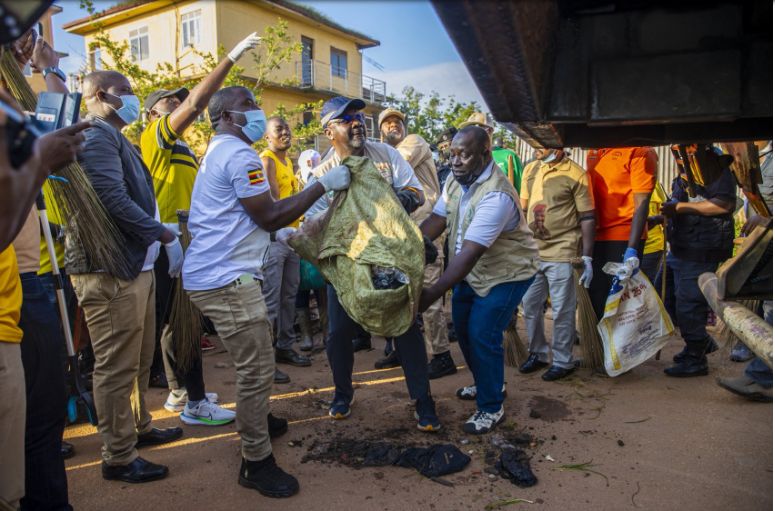
From sweeping compounds and clearing drainage channels to separating waste and ensuring proper garbage collection, residents were reminded that a clean city begins with individual action.
Buzeki made the call while participating in cleaning activities in Zone VI, Mutungo Parish, Nakawa Division, where she commended political and community leaders for embracing the initiative and mobilising residents.
“I am happy that political leaders in Kampala have embraced and supported the cleaning days and our other programmes,” she said.
She used the occasion to emphasise that residents must also meet the cost of collecting the waste they generate, urging households and businesses to engage authorised private garbage collectors and pay the approved rates.
“The NEMA Act is clear, the generator pays for the garbage. The polluter-pays principle means that whoever generates waste has a responsibility to ensure that it is properly managed. We therefore need residents and businesses to work with authorised collectors and pay the approved rates,” Buzeki said.
She explained that payments enable private waste collectors to meet operational costs, including fuel and workers’ wages.
“When you pay, you give these people money for fuel and for paying their workers. We do not subsidise these companies, so they depend on payments from you to provide the service,” she said.
Under the approved arrangement, households in informal settlements classified as urban poor pay UGX 1,000 per 50kg bag, while other domestic households and commercial premises pay UGX 3,000 per 50kg bag.
Institutions, including schools, churches, mosques and temples, pay UGX40,000 per load.
The rates, approved by KCCA Council in October 2024, are intended to keep waste collection affordable while enabling private service providers to sustain their operations.
KCCA remains responsible for waste generated at government common-user facilities, including public markets, taxi parks and health centres.
KCCA Deputy Executive Director Benon Kigenyi reinforced the message, challenging residents to look beyond their individual compounds and take responsibility for the cleanliness of their entire neighbourhoods.
“It is your responsibility to keep your area clean. After cleaning, ensure that your neighbour is also clean. If you are clean and your neighbour is not, you will import diseases,” he said.
Kigenyi warned that poor sanitation in one household can expose an entire neighbourhood to health risks, making collective action essential in protecting public health.
Nakawa Division Mayor Ali Bukeni welcomed the campaign and rallied residents to embrace proper garbage management. He also called for the construction of community drainage channels and increased sensitisation about waste collection charges.
The call for sustained community participation was echoed in Mengo Parish, Central Division, at Sserwanga Zone, where Michael Nuwagira Toyota, National Vice Chairman of the Patriotic League of Uganda (PLU), urged residents to make sanitation a daily responsibility rather than wait for organised cleaning exercises.
“It is everyone’s responsibility to ensure we have a clean city and environment by cleaning our homes, our businesses and handling garbage properly. We should be doing this every day and maintaining clean environments,” Nuwagira said.
In Mutungo, Zone VI Chairperson Adam Kibuka welcomed the initiative, thanking the Executive Director for taking the campaign directly to communities and engaging local leaders.
KCCA Director of Public Health and Environment, Dr Sarah Zalwango, urged households to practise proper waste disposal, personal hygiene and waste separation, particularly separating organic waste from inorganic materials to support recycling and recovery.
The campaign also mobilised communities behind the Weyonje Sanitation Challenge, through which KCCA seeks to encourage divisions to compete in improving sanitation and cleanliness across the city.
Simon Kaheru, East African Business Council Vice-Chairperson and a resident of Mutungo, challenged residents, including those living in gated communities, to participate in neighbourhood cleaning activities and take responsibility for shared spaces.
“If the entire neighbourhood is dirty, you are also dirty. Even those of us who are in enclosed fences should come out and support the cleaning. We make Mutungo clean, Kampala clean,” he said.
For KCCA, the ambition goes beyond organising monthly or periodic cleaning exercises. The authority wants to build a culture in which residents routinely clean their surroundings, pay authorised collectors to evacuate their waste and protect public spaces.